Depleted Uranium
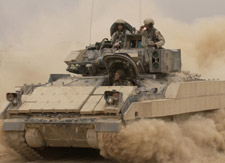
First deployed on a large scale during the Gulf War, the U.S. military uses depleted uranium (DU) for tank armor and projectiles due to its high density, helping it to penetrate enemy armored vehicles.
Uranium is a naturally occurring element that is present in air, water, soil, rocks, plants, and animals. It is a weakly radioactive substance. DU is a by-product of uranium processing. DU is what remains after some of the more radioactive components (called isotopes) are removed from natural uranium for use in nuclear fuel. Therefore, DU is 40% less radioactive than natural uranium but has the same chemical properties.
The Metal Exposures & Depleted Uranium (MEDU) Surveillance Center
The Metal Exposures and Depleted Uranium (MEDU) Surveillance Center is located at the Baltimore VA Medical Center.
The Center has two missions related to DU:
- To provide screening, testing, and follow-up for 1991 Gulf War Veterans exposed to DU through ‘friendly fire’ incidents, and
- To offer DU screening and testing to any Veteran worried about DU exposure.
Depleted Uranium
Chemical used in tanks and in bullets that penetrate enemy armored vehicles
When a vehicle is hit and penetrated by a DU projectile, it splits into small shards and bursts into flames. The projectile fragmentation may fill the vehicle with flying metal fragments, particles, and dust.
Inhalation, oral, or dermal (wounds)
Southwest Asia, South-Central Asia, Western/Central Europe, Southeastern Europe
Gulf War, Operation Joint Endeavor (OJE), Operation Enduring Freedom (OEF) / Operation Freedom's Sentinel (OFS), Operation Iraqi Freedom (OIF) / Operation New Dawn (OND)
1990-1991, 1992-1995, 2001-present
The two primary health concerns related to DU exposure are radiation and heavy metal toxicity.
- Radiation - since DU is less radioactive than naturally occurring uranium, this should not be a significant source of concern.
- Heavy metal toxicity - The first organs of concern are the kidneys. Currently, there is no evidence of long-term health effects in Veterans as a result of embedded DU fragments.
The potential for health effects from internal exposure is related to the amount of DU that enters a person’s body. Inhaled DU particles are likely cleared from the lungs over several years. DU fragments may remain for many years. Other health effects being studied are the effects on the kidneys and on bone mineral density.
- Depleted Uranium Fact Sheet
- https://www.publichealth.va.gov/docs/depleted-uranium/MEDU_DU_INFO_VETERAN.pdf#
- https://www.publichealth.va.gov/exposures/depleted_uranium/index.asp.
- Depleted Uranium webpage
- https://health.mil/Military-Health-Topics/Health-Readiness/Environmental-Exposures/Depleted-Uranium .
- DoD Depleted Uranium (DU) Library
Get a Registry Evaluation
- Environmental Health Coordinator
- https://www.publichealth.va.gov/exposures/coordinators.asp
Contact your local https://www.publichealth.va.gov/exposures/coordinators.asp, https://www.oefoif.va.gov/map.asp, or VA Primary Care Team about getting a registry evaluation.
WRIISC Link
- War Related Illness and Injury Study Center (WRIISC)
- https://www.warrelatedillness.va.gov/WARRELATEDILLNESS/referral/index.asp
For evaluation for difficult-to-diagnose conditions, contact your local https://www.warrelatedillness.va.gov/WARRELATEDILLNESS/referral/index.asp.
Depleted Uranium Follow-Up Program
- https://www.publichealth.va.gov/exposures/depleted_uranium/followup_program.asp
"Depleted Uranium Follow-Up Program screens and monitors Veterans for health problems associated with exposure to depleted uranium (DU). The program is especially geared to Veterans who were on, in or near vehicles hit with 'friendly fire'; rescuers entering burning vehicles, and those near burning vehicles; salvaging damaged vehicles; or near fires involving DU munitions. VA requires active duty service in any of the conflicts listed below to qualify for the DU Follow-Up Program:
- 1990-1991 Gulf War
- Bosnia
- Operation Enduring Freedom
- Operation Iraqi Freedom
- Operation New Dawn
- For more information, visit: https://www.publichealth.va.gov/exposures/depleted_uranium/followup_program.asp
1990 2100 Gulf War, Operation Enduring Freedom (OEF) / Operation Freedom's Sentinel (OFS) Southwest Asia, South-Central Asia